The Doctor
And the Dreams

The sun hung low in the sky, silhouetted behind smokestacks that seemed a mile high, in a city that reeked of dirt and death. How can a man learn to heal the sick in a place so ill it will not let the sick escape? John had spent years as Mr. Williams, but now they called him Dr. Williams. It was an honor, but to him it felt like a joke told at a funeral. This city, like every other western city on Earth, had turned its back on healing and settled for treatment. This raised his hackles. To dismiss the eastern ways, the southern ways, the far western traditions, simply because they believed they had found something that suited them better. Money. That was their treatment. That had always been their treatment.
John stared out the window as the setting sun illuminated the sickness hanging in smoke above the streets of London, a haze that pressed down over the tightly packed rooftops and settled all the way to the narrow cobbled streets below like a burial shroud that never quite finished falling. The last of them were walking the streets now. Soon they would retreat into their homes and lock themselves in for the night, as the sickness flowed through the city like blood through a wound that would not close. They were locking themselves in not only from the sickness of disease and filth, but from the sickness of the soul that had taken this city and was eating it quietly from the inside.
On the rough-hewn table in front of him lay a set of doctor’s tools, mostly knives and picks, unrolled so they could be inspected, cleaned, and disinfected. He had found only one thing that would truly disinfect them, and that was fire, but a kiln was expensive, so he used the next best thing. In the center of the old table sat a bottle of homemade moonshine, as the colonists called it. It tasted horrible. It tasted like burning. But it worked, and more importantly, it killed the disease hiding in the blades. It cleaned almost as well as extreme heat, and it asked no questions. Now Dr. Williams sat watching the last of the sunset and cleaning his tools, hoping beyond hope that they would still be clean tomorrow. That he would still be clean tomorrow.
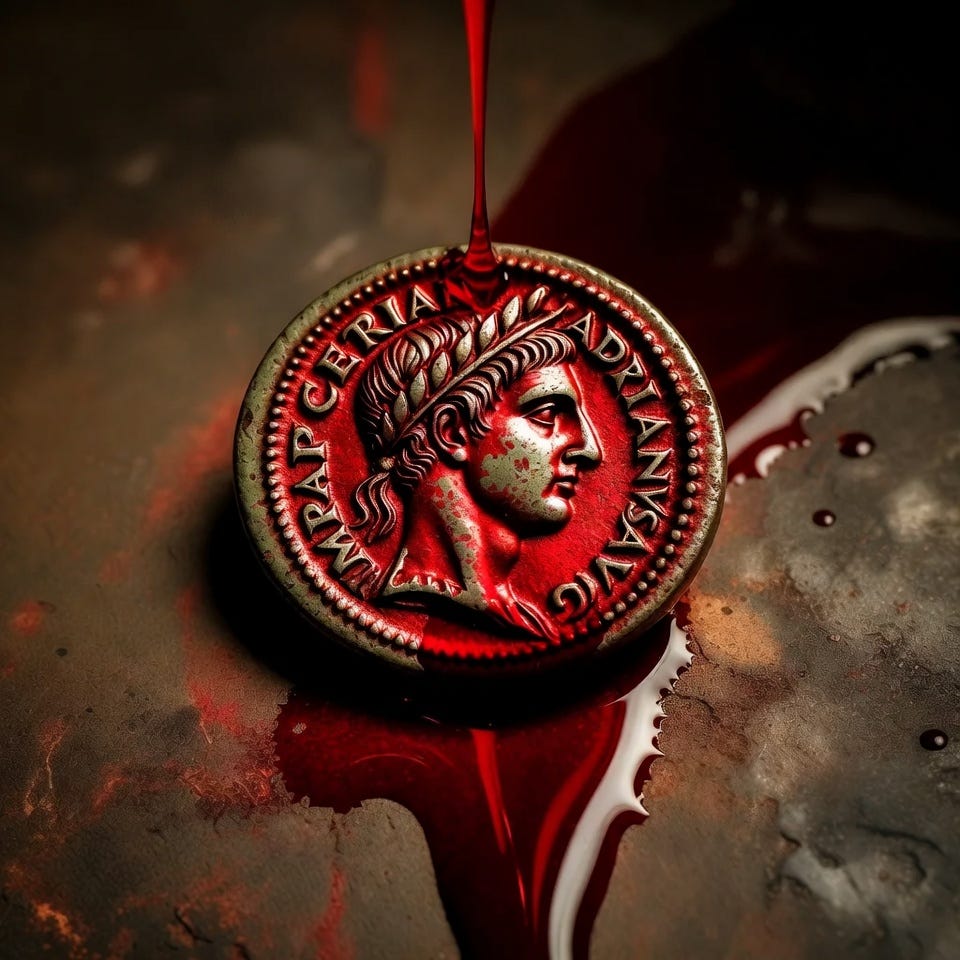
Two more things adorned the table, arranged almost ceremonially, as if placed there by hands that understood the weight of symbols. A medical book, Quain’s Dictionary of Medicine, thick and authoritative and full of things that could save a life or end one depending on who held the knowledge. And a silver coin. On one side was the profile of what looked like a Roman emperor, a wreath crowning his forehead, and on the back were words written in Latin. John knew it was a Roman coin from the rule of Hadrian. He had kept it at first as a reminder that civilization could never truly rule the nature of man, and later he kept it because he found he could not let it go, the way a man cannot let go of a wound he keeps returning to touch. Rome had been the pinnacle of civilization, but Hadrian’s wall had been built to keep out the unknown, the Picts, the things that civilization could not explain or contain. It had failed. The book represented his fight against that same nature. He wanted to heal, not to open. He wanted to close wounds, not make them.
The sun finally set as he watched. A single tear rolled down his cheek in a thin rivulet, tracing the line of his face like ink finding the grain of old wood, as the last rays vanished for another day. When the light was fully gone he lit the gas lamp beside the table and his chair, casting a dim glow filled with deep shadows across the room. As he looked out the window from his third-floor flat, he could see similar flickering lights being kindled as far as his eye could see, all over the city, as people desperately tried to keep the dark at bay. He imagined even the Queen had her lamps lit tonight, for the same reason as the common folk, though she would never have admitted it. The dark was the great equalizer in London these days.
The denizens of the night had begun to move. Horse-drawn carriages hurried through the streets, ferrying those who had decided too late to go home. People on foot moved in quick, hunched steps from one streetlight to the next, collars turned up as if against a winter that had not yet arrived, heads turning in all directions as they walked. There was something animal in it, the way a prey animal moves through open ground, never still, never certain. It seemed there was a monster loose in London. It was not a werewolf, or a vampire, or anything belonging to the comfortable darkness of old stories. This was something worse, because it was real. This was a demon that hunted in patience and in silence. It did not hunt every night, but when it found its victim it studied them first, their habits, their fears, their small dreams and the particular way each of them carried their loneliness. It learned what made them move through the world. And then it learned more, in ways that could not be unlearned.
He reached out and picked up the silver coin. How many hands had held it since it was minted. It had survived the Romans, the Gaels, the Vikings, the Saxons, the Angles, the poor, and the rich. Never melted down, never cut, never destroyed, while everything around it crumbled and was forgotten. He liked that about the coin, or he had once. It had survived buried in the dirt of Chesterholm until it was found in 1787 by a man from Chesterfield. It had traveled little since then, until John purchased it in an antique shop some five years ago. Now it rested in his hand and felt warmer than silver ought to feel.
He gripped the coin tight, as if letting it go would end something. Then he flipped it into the air. It spun in a fast, tight arc, not lazily as a coin ought to spin but rapid and purposeful, almost like a living thing finding its orientation. Then he caught it again in the same hand. He held it in his closed palm for a moment before opening his fingers slowly.
Heads.
John let out his breath and took a measure of the moonshine. It went cool into his mouth but the alcohol burned his nose and then his throat as he swallowed. He knew exactly why it burned. His books had explained the mechanics of it in precise and clinical language. He found he could not stop knowing things, even the things he would rather not know.
Tonight, he decided, he would stay in and read. Something by Dickens perhaps, or an American author, with their tales of the south and the recent war. No. That would not do. He settled on Pride and Prejudice. Less death. More drawing rooms. He could use a quiet night, a night without copper on his tongue and screaming in his sleep. Dr. Williams retired to his parlor, lit another gas lamp, doused the one in the kitchen by the window, placed the silver coin into the pocket of his robe, pulled out the book he had chosen, poured a glass of sherry, and settled in for the night. The hours passed slow and blessedly quiet. Before it grew too late he could feel sleep reaching for him with its soft, inevitable hands.
No monsters tonight, he told himself.
He was wrong, as he was always wrong.
When the dreams came they were not dreams at all. They were the torments of memory and witness sewn together into something his waking mind could not hold. First came his time in Bhutan, the first time he had killed a man. He had been serving as a medic, but even medics were sometimes required to defend their own lives with the same hands that were meant to preserve them. The memory haunted him still. Neither man had known the other, and the truth that broke him most quietly was the knowledge that in any other time or place they may have been friends. He had choked the life out of him in silence, hiding under a tree in a thicket of bush, with the man’s battalion not two hundred yards away, close enough to hear them talking. That was how the night always began. He reminded himself each time that these were memories, not dreams. The distinction had begun to matter less.
Then the other memories rose, the ones that were not his own.
Scenes of the monster stalking its prey through the dark streets of London, moving with a terrible patience. Early on there had been men and women, killed quickly and then opened with the careful efficiency of someone who had studied where the body kept its secrets. He did not eat them. He examined them, the way a scholar examines a text, and sometimes he took a piece as a man might press a flower between pages, and these pieces he sliced thin and discarded or fed to the stray animals of the streets to rid himself of the evidence. Now, when the monster hunted, he chose those that no one would miss, or believed he did. The street children, with no one to name them or mourn them, had gone unnoticed, but somehow five of the others had found their way into the light of public knowledge and the columns of the newspapers.
He watched in the dream-dark as the beast tracked a man, this was before the news, before the panic, before the world understood that something walked among them that should not exist. The world did not yet know. This was the first human kill, the crossing of a line that, once crossed, could not be uncrossed. John never learned the creature’s name, and neither had the newspapers. He only watched as the hands moved, tortured, sliced, and inspected with the calm deliberation of a craftsman. John was witness to it all. The horror of it settled into his chest like cold water into stone, finding every crack. But the knowledge he received was something no classroom had ever given him, no textbook ever contained. He had lived with these visions since he was twelve years old, waking with blood he had not shed drying in his dreams, and since the monster had moved on to human prey, John had learned more of human anatomy than any surgeon alive could claim. He carried the guilt of that learning like a stone in his gut that never grew lighter.
By the time morning came he had relived every kill the monster had made, one by one, in the enforced intimacy of dreaming. The animal killings had blurred and faded, as though the monster’s own memory held them as insignificant, hardly worth preserving. What the creature craved, what it returned to again and again, was something only a human being could give it. John believed it was fear, and the specific quality of pain that came from a mind capable of understanding what was being done to it. He only hoped the monster would somehow die. There was no other way. As long as the beast lived it would hunt, and open, and learn, and take its cold satisfaction from the suffering of the living.
Then the first name appeared in the newspaper, accompanied by a grainy artist’s rendering of the victim. Mary Ann Nichols. A prostitute, the paper said, and he recognized her from the dream. She had seen the monster clearly but had not recognized what she was seeing. She had seen a man, only a man, and had spoken to him with the ordinary wariness of a woman who had learned to be careful. There was no awareness yet that a monster moved among them wearing a human face. Her words reached John only as distant murmurs, muffled and indistinct, for he saw only through the monster’s eyes and not her own. He did not see inside her mind. He saw only what the beast saw as it studied her, catalogued her, and then moved. It was on her in a moment. There was nothing of desire in it. It was brutal and precise and clinical in the way that made it somehow worse than rage would have been. John learned more about anatomy that time than he had wished to know, and could not unlearn a single detail.
Every night after that, from the moment sleep took him, which he fought with everything he had, the dreams arrived without fail. Every one. After Mary there was Annie Chapman, Elizabeth Stride, Catherine Eddowes, and Mary Jane Kelly. Three men as well, whose names the newspapers never ran, for reasons John could not fathom and found deeply disturbing in their own right. He may not have known the names of those men, but he witnessed their deaths in every particular, every sound and motion preserved in the amber of the monster’s memory. He heard all of them beg, plead, and bargain with a creature that had no capacity for mercy and no interest in developing one. And all along John was forced to watch, unable to close his eyes, unable to stop his ears, unable to look away from any of it, experiencing the visceral fact of each death filtered through feelings that were not his own, the monster’s cold satisfaction, the victims’ terror and pain pressing through from some thin place between their experience and his. It built in him an empathy so raw and so deep it had begun to feel like its own kind of wound.
The sun broke through the window and washed over his face, but it was not enough to dry the tears that had dried on his cheeks in the night. The light of morning was John’s only reprieve, the single boundary the beast seemed to respect. He had come to understand that darkness was its domain, that it gathered itself in the long hours and rested in the light, coiled and patient, while John walked the waking world carrying everything it had shown him. The monster needed to die. He had known this for a long time. He simply had not yet found a way to kill it that would not kill himself in the same stroke, and had not yet decided whether that was a reason to hesitate or a reason to hurry.
The sun had barely cleared the rooftops when John pulled the hidden volumes from the false bottom of his medical trunk. Three books, wrapped in oilcloth and bound with black ribbon, the ribbon darker than it should have been, as if it had absorbed something from the pages it held closed. He had bought them two years earlier from a man in a back alley in Whitechapel who swore they were banned in every proper hospital and laughed when he said it, the kind of laugh that meant he was not joking. One was a German text on the nervous system and what it called the shadow twin. Another was a handwritten journal by a French alienist who claimed that certain men carried two souls in one body, not as metaphor but as medical fact. The third was the oldest, its pages brittle as dried leaves, full of drawings of the brain laid open and labeled with words like the beast within and the seat of the shadow, the handwriting growing less steady toward the back of the book, as if the author had been deteriorating as he wrote.
He spread them across the table beside the map. His fingers trembled faintly as he turned the pages. He had read them a hundred times, but now he read them like a drowning man reads water, searching for any line that might tell him how to reach the beast before it reached another.
The dreams had grown sharper in recent weeks. He could smell the river mud on the killer’s boots. He could hear the faint chime of a particular church bell that rang just before each strike, as if the city itself were keeping time for the murders. He could feel the weight of the knife in the hand that was not his own, the specific balance of it, the way a familiar tool settles into a practiced grip. Every morning he woke with the taste of copper in his mouth and new red lines drawn on the map, lines he did not remember drawing, though the ink was always dry.
He left the flat before the neighbors stirred.
First he walked to Buck’s Row. The place where Mary Ann Nichols had died was still marked by a dark stain on the cobblestones that the rain had never quite managed to wash away, as if the stone itself refused to forget. He knelt in the gutter, running his fingers along the seams between the cobbles, the way a man touches an old scar. Nothing spoke to him. Only the faint echo of a woman’s muffled scream in the archive of his memory. He stood, brushed the filth from his knees, and moved on.
Hanbury Street next. The backyard where Annie Chapman had been found. The gate was locked but he climbed it without hesitation, the way a man moves through a place he has visited many times before in the dark. He stood where the body had lain. He closed his eyes and let the dream-memory surface. The killer had paused here. Had taken something small and deliberate. A piece of intestine, removed with the unhurried care of a man who knew precisely where to cut and had cut there before. John opened his eyes and looked at the surrounding buildings. One window on the second floor of the house opposite commanded a clear view of the yard. He noted the address in his notebook. A possible witness. Or a possible neighbor who had learned to look away.
He walked the routes the killer had taken after each murder, matching the paths from the dreams to the real streets beneath his feet. Mitre Square. Dorset Street. The alley behind the International Working Men’s Educational Club. Every location the newspapers had named, and a few they had not. He searched for anything the police had missed. A scrap of cloth. A dropped button. A smear of blood on a wall that someone had decided not to clean. He found nothing dramatic. Only small things that tightened something in his stomach.
A boot print in soft mud near Mitre Square that matched the exact size of his own boots.
A faint smear of blood on a windowsill two streets from his flat, at a height consistent with a man his own height brushing against the sill as he passed.
A piece of cheap red ribbon caught on a nail outside a pub he passed every morning on his way to the hospital. He stopped and stared at it for a long time before walking on.
Each small thing pointed closer. Not toward some distant stranger lurking in a far corner of the city. Toward someone in his own neighborhood. Someone who walked the same streets and knew the same alleys and could move through this part of Whitechapel without drawing a single glance, because he belonged here. Because he had always been here.
By the time the sun began its descent John was back in his flat. He stood at the window, looking down at the narrow cobbled street below with the fixed attention of a man who has stopped pretending he does not know what he is looking for. The same figures moved below him every evening with the reliable rhythm of routine. The same costermonger with the limp. The same washerwoman with the three small children who always walked too close to her skirts. The same quiet man who lived two doors down and always tipped his hat when they passed on the stairs, always at the same angle, always with the same small smile that never quite reached his eyes.
John’s hand tightened on the windowsill until the wood creaked under his grip.
The connection was too exact. The dreams were too specific. The beast did not come from some distant and unknowable corner of London. It lived close. It had always lived close. Close enough that when it moved, John felt the movement in his own bones, in his own blood, in the particular ache behind his eyes that came every time the monster went out into the dark.
He whispered to the empty room, his voice cracked and hoarse, the voice of a man who had been arguing with himself for years and was losing. “It’s one of them. One of us. One of me.”
He turned back to the table. The coin lay there, tails up. The medical books lay open. The map was covered in new red lines that all pointed inward, converging on the heart of Whitechapel, converging on the street outside his window, converging on the address he had known by heart since the day he moved in.
He did not flip the coin tonight.
He simply sat down, picked up the scalpel, and studied his own reflection in the blade for a long time, watching the gas lamp flicker in the polished steel and seeing, in the hollows of that dim and wavering face, something that looked back at him with an expression he had not put there.
The monster was close.
And John was running out of places to look that were not his own shadow.
The neighbor’s voice drifted up the narrow stairwell just as John was turning his key in the lock.
“Evening, Jack. You’re out late again. Mind the fog, aye?”
John froze. Hand still on the latch. The word landed like a scalpel finding a nerve. Jack. Not John. Never John to anyone who knew him here. He stood in the darkness of the landing for a moment that felt much longer than a moment, then forced a thin and unconvincing smile down into the gloom below.
“Evening,” he answered. “Mind it yourself.”
He stepped inside and closed the door before the man could say more, and stood with his back against it in the dark, not moving, listening to the silence of his own flat press in around him. The map on the wall, the red lines, the pinned newspaper clippings with their artist’s renderings and their columns of careful horror, all of it pointed inward now, tighter and tighter, a spiral with no good center. The beast had never been far from this room. It had been breathing the same coal-smoke air, climbing the same stairs, buying bread from the same costermonger, passing the same neighbors with the same pleasant and unremarkable nod.
He had known. He understood that now with the full and terrible clarity of a diagnosis made too late. Deep in the place where a man keeps truths he cannot bring himself to look at directly, he had known since the night he brought the coin home. The dreams had begun that same week. The first killing had followed within the month. And still he had told himself he was only a doctor, only a healer, only a man who studied pain so that he might eventually learn to end it. He had been very thorough in his telling of himself this.
He sat at the table. The silver coin waited beside the moonshine bottle, which was mostly empty now. He picked the coin up, felt its warmth against his skin, the warmth that silver should not have, and flipped it high into the dim gas-lit air. It spun and caught the light and fell.
Heads.
John let out a long slow breath that tasted of copper and old fear. He poured the last of the moonshine and drank it in one burning swallow. Then he walked the floor. He read aloud from Quain’s Dictionary until his voice gave out entirely. He pressed the tip of the scalpel into the meat of his own forearm, just enough to feel something sharp and real and anchored in the present moment. But the beast was always stronger when the dark deepened. It reached inside him with familiar hands and stole the strength from his legs and the fire from his mind, patient and methodical, the way it was patient and methodical in everything it did.
His eyelids grew heavy as iron weights.
“No,” he said, to the room, to himself, to the other thing that lived behind his eyes. “Not tonight.”
He pulled on his coat and slipped out into the fog.
Two streets over stood the small, dim shop of an apothecary who dealt in things that polite doctors pretended did not exist and visited only after dark. John bought a paper packet of white powder without meeting the man’s eyes and paid double without haggling. Back in the flat he mixed it into the last of the sherry and drank it down. The powder set his heart hammering and his thoughts racing, bright and sharp and crowded, too many of them, pressing against the inside of his skull.
For a time it held the beast back. His eyes stayed open. His hands steadied. Then the lull came anyway, softer than sleep, sweeter, more patient than anything John had in him to outlast.
A voice spoke inside his skull. Not loud. Not urgent. The calm and cultured voice of a man who has never once doubted himself and finds the doubt of others quietly amusing.
“Why fight me, John? We are the same coin. Heads and tails. Two faces of one truth. I give you wisdom no living man has ever held. Every artery. Every nerve. Every last secret the body keeps when it is finally opened and the pretense of life is finished. You learn more in one night with me than in a lifetime in your precious hospitals. Admit it. You know you do.”
John answered through teeth he had not realized he was clenching. “You call it wisdom. I call it murder. I cannot save a single soul while you wear my hands. I heal by day and you destroy by night. One of us must end.”
The voice laughed. Low and warm, the way a gentleman laughs at a clever observation made at dinner. “Hyde. You may call me Hyde, since you insist on formality between us. And tell me, Doctor, how many patients have you saved this week with the knowledge I gave you? How many women still breathe because you knew exactly where to cut, and exactly how deep, and exactly what to leave alone? I am not your enemy. I am the part of you that is honest about what we are. Together we could become something the world has never seen and could not forget.”
“I am a doctor,” John said. “Not a killer.”
“We are both,” Hyde said pleasantly, “and one of us has the courage to admit it.”
The argument turned back on itself again and again, two voices in one throat, wearing the same body between them, until the drug began to fade and Hyde’s will pressed in like a tide finding low ground. In the end John stopped fighting, not with surrender but with cold and terrible calculation.
“Very well, Hyde. We go out together tonight. But on my terms. Only my terms.”
Hyde’s voice settled into something warm and satisfied. “I like this partnership already.”
John changed into the roughest clothes he kept for visiting the worst of the tenements, a torn coat, a muffler pulled high, a cap pulled low. Clothes that smelled of the streets because they had been worn in the streets, sewn into the landscape of Whitechapel by repetition and grime. He looked like any other man down on his luck and moving through the fog with no particular purpose. He was invisible. Hyde purred with the pleasure of it.
They stepped out together into the dark and the cold and the smell of coal smoke and river mud.
John chose the prey. A young woman standing beneath a single gas lamp, shivering in the cold, humming a broken tune to herself and stamping her feet against the chill. Thin. Young. Desperate enough to be still standing here this late. He felt Hyde stir with anticipation beside him in the architecture of his own skull.
“She will make a magnificent specimen,” John heard himself whisper, and felt sick at the shape of the words in his mouth. “The organs still warm. The veins perfect for study.”
Hyde answered with something close to joy. “And her soul. Oh, her soul will be extraordinary.”
They moved forward through the fog. The knife was already in John’s hand, held flat against the back of his wrist, the way a surgeon holds a blade when he does not want to be seen holding one. The woman never heard them. The fog swallowed sound.
At the last possible moment, with every remaining piece of himself that he could find and gather, John seized control of the right hand. The blade flashed upward and drove into Hyde’s own gut, aiming for the heart, but the beast reacted with the speed of something that had been waiting for exactly this, and the hand moved at the last instant. The knife tore sideways instead of straight in. Hyde roared inside him, wrenching the arm aside with a violence that snapped John’s teeth together.
The woman screamed and ran into the fog and was gone.
Hyde regained control of the right arm and wrenched the knife away from the wound with a grunt of pain, gripping it hard. The left arm was still John’s. He had only seconds. The left hand moved faster than thought, dragged the wrist across the edge of the blade, and blood came in a hot sheet down his sleeve. Hyde reacted immediately, dropping the knife to the cobblestones with a clatter that rang in the quiet street. John threw their shared body to the ground, reaching for the blade. They rolled and thrashed in the wet dark, two wills fighting inside one skull, one set of limbs tearing against itself, the way a man drowns when he fights the water.
Hyde kicked the knife away. John lunged after it across the wet cobbles, fingers finding the handle and closing around it. With the last of what he was and what he had ever been, he brought the blade up and drew it across Hyde’s throat in one clean, deep, surgical stroke. The cut was precise. He had practiced it in his mind for years, though he had not known until this moment what he had been practicing for.
Both of them felt the pain. Both felt the blood. They were going to die, and still they fought, Hyde trying to tear the hands away from the wound and John trying to hold it open, each fighting the other’s instincts with the last of a shared strength that was running out fast. John welcomed what was coming. Hyde raged against it with the fury of something that had never once accepted any limit placed upon it.
The body grew still.
They lay together in the street under the gaslight, bleeding out into an ever-widening pool of crimson on the cobblestones, two men in one ruined body, dressed like a drunk who had lost a fight that had been a long time coming. The fog moved in slowly, the way it always moved in London, as if the city were breathing, and closed over them.
The silver coin slipped from the pocket of the torn coat and lay on the cobblestones beside the body, face up, catching the gaslight with a faint gleam.
Heads.
Morning came gray and cold and indifferent, the way London mornings always came.
A young man named Henry H. Holmes found the body first. He was thin and sharp-eyed and already carried in his face the particular look of someone who had learned very early that survival belonged to those who noticed what other people walked past. He moved through the world like a man who was always taking inventory. He knelt beside the body quickly, with the practiced efficiency of someone who had done this before, and searched the pockets. He took the knife, wiped clean on the dead man’s coat. He took the identification papers. He took a small notebook filled with cramped handwriting and red lines on folded maps. And last of all, almost as an afterthought, almost as if his hand had found it of its own accord, he took the silver coin.
It was heavier than it should have been. Warmer than silver had any right to be.
When the first constable’s whistle sounded two streets over, Holmes was already gone, moving through the alleys with the ease of a man who knew them well and had already chosen which turns to take before the first sound reached him. Behind him on the cobblestones the body lay cooling, the pool of blood spreading thin and dark in the morning light.
The police listed the corpse as unknown male. Victim of a violent altercation, cause uncertain. No name. No history. No one came forward to claim him. Just another body in Whitechapel, in the season of bodies, in the year that would be remembered for such things.
Weeks later, when inquiries were made regarding the whereabouts of Dr. John Williams, the response came back clean and simple and final. The gentleman had booked passage to the United States. The trail ended at the docks and there was nothing after it. No further inquiries were made.
In a cramped and swaying cabin aboard the steamer, three days out of Southampton, Henry H. Holmes sat with the dead man’s belongings spread on the small table in front of him. The money he had found in the flat was more than he had hoped for. The medical books were interesting, full of careful annotations in a hand that grew less stable toward the later entries. The notebook with the red lines was deeply interesting, the work of a man who had been tracking something with the focused obsession of a hunter or a scholar or a man who was very afraid.
But it was the coin he kept returning to.
He turned it in his fingers, watching the gaslight move across the old silver, reading the Latin he did not understand, tracing the profile of the emperor on the face side. It was warm. It had been warm since the moment he picked it up from the cobblestones and it had not cooled since. He told himself this was because he had been holding it, transferring his own warmth into the metal. He had been a medical student long enough to know the mechanics of heat transfer. He was a rational man.
He placed the coin on the table and watched it for a moment without touching it.
It was still warm.
He pressed his palm over it and felt something that was not quite a sound and not quite a sensation but existed in the narrow space between those two things, like a vibration felt through stone, like the particular quality of silence in a room where something has just happened. He pulled his hand back. Looked at the coin. Picked it up again.
That night, for the first time in his life, Henry H. Holmes dreamed.
He had not been a man who dreamed before. He had always slept clean and dark and woke refreshed, which he had always taken as evidence of an orderly mind. But that night the dark opened up and let him through, and what was on the other side was bright and surgical and terrible and fascinating in equal measure. He saw streets he had never walked. He smelled river mud and coal smoke and the particular copper smell of opened bodies. He felt the weight and balance of a knife in a practiced hand. He watched with perfect clarity as things were done to people that should not be done, and found, to the part of him that was still watching from a distance, that he could not look away, and did not entirely want to.
He woke before dawn with his heart hammering and the taste of copper in his mouth and the coin clenched in his fist so tightly that the profile of the emperor had left its impression in the meat of his palm.
He lay in the dark of the cabin, listening to the engine and the water, and felt something settle into place inside him. Not like something being added. Like something being recognized. Like a room in a house he had always owned but had never yet opened.
A voice spoke inside his skull for the first time. Calm. Cultured. Pleased.
“Hello, Henry. I have been looking for someone like you for a very long time. A man of science. A man of ambition. A man not encumbered by the particular weakness that undid my last host. He was always fighting himself. I don’t think you’ll have that problem.”
Holmes said nothing. Lay still. Listened.
“I have so much to show you,” the voice continued, warm with the promise of it. “So much knowledge. Such a thorough understanding of what the body conceals. You are going to build something magnificent, Henry. Something the world will not be able to look away from, even when it tries. Something they will still be talking about a hundred years from now.”
Holmes opened his fingers slowly. Looked at the coin in the thin light coming under the cabin door. Looked at the emperor’s profile, the wreath, the Latin words on the reverse that he could not read.
He closed his fingers around it again.
“Tell me more,” he said.
Outside, the Atlantic moved beneath the hull in the dark, indifferent and deep, carrying its cargo westward toward a city that had not yet learned to be afraid.
The coin had found its new home.
And it was warm all the way across the ocean.